Get Marketing Insights First
Subscribe to receive actionable strategies, growth tips, and industry insights delivered straight to your inbox.

Still running your business the same way you did years ago?
Your traditional business already has a strong foundation. Now it’s time to think bigger. Learn how to adopt a startup mindset, leverage technology, and create systems that can take your business from local success to scalable growth. The future belongs to businesses that innovate, adapt, and evolve.
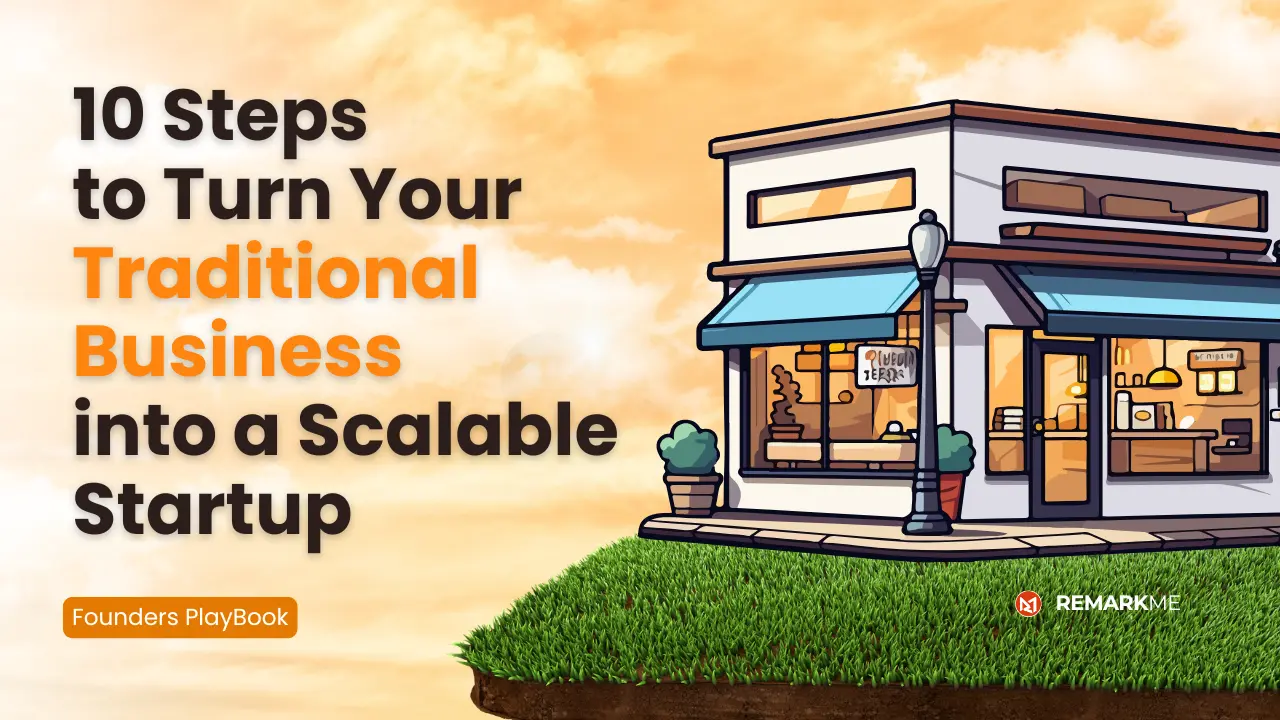
Traditional businesses have long been the backbone of economies worldwide. From family-run stores and local manufacturers to service providers and wholesalers, these businesses have built trust, created jobs, and served communities for generations.
However, the business landscape is evolving rapidly. Consumer expectations are changing, digital technologies are reshaping industries, and competition is no longer limited to a local market. Aaj ke digital era mein, sirf ek physical store ya existing customer base par dependent rehna long-term growth ke liye sufficient nahi hai.
This is where startup thinking becomes important.
Startups are designed for growth. They focus on innovation, scalability, technology, and solving customer problems at a larger scale. The good news is that traditional businesses already possess strong foundations such as industry experience, loyal customers, and operational knowledge.
By combining these strengths with startup principles, entrepreneurs can unlock new growth opportunities and future-proof their businesses.
Here are 10 Practical Steps to help transform a traditional business into a scalable startup.
Every transformation begins with mindset.
Traditional businesses often prioritize stability and consistency. While these qualities are valuable, they can sometimes limit growth. Startups, on the other hand, embrace experimentation, innovation, and continuous improvement.
Business owners must shift their thinking from simply maintaining operations to actively pursuing expansion opportunities. Instead of asking, “How can we protect our current business?”, ask, “How can we grow ten times faster?”
Agar aap growth ko seriously lena chahte hain, toh “hum hamesha se aise hi karte aaye hain” wali thinking se bahar nikalna hoga. Markets evolve constantly, and businesses that adapt quickly usually stay ahead.
Successful entrepreneurs understand that calculated risks, learning from failures, and remaining flexible are essential for long-term success.
Many traditional businesses primarily serve customers within a specific geographic area. While this model can be profitable, it often limits scalability.
Startups grow because they focus on solving problems that affect a much larger audience. The bigger the problem, the greater the growth potential.
Take time to understand your customers deeply. What challenges do they repeatedly face? What frustrations remain unresolved? Customer complaints often reveal significant business opportunities.
For example, many local coaching institutes transformed into successful EdTech companies by recognizing that quality education was inaccessible to millions of students beyond their cities.
Agar aap business ko next level par le jana chahte hain, toh local opportunities ke saath broader market needs ko bhi identify karna zaroori hai.
Digital transformation is no longer optional. It has become a necessity for businesses that want to scale efficiently.
Manual processes may work for smaller operations, but they often become obstacles during expansion. Digitization helps businesses improve efficiency, reduce errors, and make faster decisions.
Implementing digital accounting software, inventory management systems, customer relationship management tools, and cloud-based collaboration platforms can significantly improve operations.
Imagine managing hundreds or thousands of customers manually while competitors automate customer interactions and track real-time business performance. Over time, this efficiency gap can directly impact growth.
Aaj ke time mein, technology ko ignore karna business growth ko slow kar sakta hai. Even small digital improvements can create substantial long-term benefits.
One of the defining characteristics of startups is scalability.
A scalable business can increase revenue significantly without proportionally increasing costs. Traditional businesses often require additional manpower, infrastructure, and resources as they grow.
Startups design systems that allow them to serve more customers efficiently. This could involve subscription-based services, digital products, franchising models, or online platforms.
For instance, a local training institute that launches online courses can serve students nationwide without opening multiple physical branches.
Business owners should regularly ask themselves: Can my business serve ten times more customers without ten times higher expenses?
If the answer is no, it may be time to redesign the business model.
Technology acts as a growth accelerator.
Today’s startups use technology to improve productivity, automate repetitive tasks, and deliver superior customer experiences. Traditional businesses can achieve similar benefits by strategically adopting relevant technologies.
Artificial Intelligence, cloud computing, e-commerce platforms, automation tools, and data analytics can help businesses operate more efficiently while reducing costs.
For example, AI-powered chatbots can provide customer support around the clock, while marketing automation tools can nurture leads without manual intervention.
Yeh approach business ko next level par le ja sakti hai. Businesses that leverage technology effectively often gain a strong competitive advantage.
Customers remember brands, not just products.
Many traditional businesses focus heavily on sales but invest very little in brand building. However, a strong brand creates trust, differentiation, and customer loyalty.
Your brand should clearly communicate who you are, what you stand for, and why customers should choose your business over competitors.
Storytelling also plays a crucial role. People connect with authentic stories, values, and missions. Family businesses, in particular, often possess rich histories that can strengthen their brand identity.
In an increasingly competitive marketplace, strong branding can become one of your most valuable assets.
Many traditional businesses rely heavily on founders or key employees. While this approach may work initially, it creates significant scalability challenges.
A business cannot scale efficiently if every decision depends on one person.
Successful startups build systems, processes, and standard operating procedures that ensure consistency across operations. Documented workflows simplify employee training, improve efficiency, and reduce operational risks.
Imagine if your business continued operating smoothly even when you were away for several weeks. That is the power of systems.
Scalable businesses are built on processes, not personalities.
Behind every successful startup is a strong team.
As businesses grow, founders cannot manage every task independently. Hiring talented individuals who share the company’s vision becomes essential.
Modern businesses require employees who are adaptable, proactive, and willing to learn continuously. Skills remain important, but attitude and cultural fit often determine long-term success.
Jab team business vision ko samajhkar kaam karti hai, tab growth naturally accelerate hoti hai.
Investing in employee development, leadership training, and skill enhancement programs creates a culture of innovation and accountability. Such cultures often become powerful growth engines.
Customer expectations have changed dramatically.
Modern consumers expect seamless experiences, personalized interactions, and rapid responses. Businesses that fail to meet these expectations risk losing customers to competitors.
Customer feedback should be treated as one of the most valuable business assets. Reviews, surveys, social media interactions, and direct conversations provide critical insights into customer needs.
Startups excel because they continuously listen, learn, and improve.
Businesses that regularly act on customer feedback often build stronger relationships and higher customer loyalty. In many cases, satisfied customers become brand advocates who drive organic growth.
Scaling a business often requires capital.
Many traditional businesses rely exclusively on internal profits for growth. While bootstrapping remains a viable approach, external funding can accelerate expansion when used strategically.
Options such as angel investors, venture capital, strategic partnerships, and government support programs can provide additional resources for growth.
However, funding should never replace a weak business model. Entrepreneurs should seek external capital only after validating demand, refining operations, and establishing strong business fundamentals.
Capital works best when it amplifies an already successful growth strategy.
| Factor | Traditional Business | Startup Approach |
|---|---|---|
| Primary Goal | Stability and Profitability | Rapid Growth and Scalability |
| Innovation | Limited and Periodic | Continuous and Experiment-Driven |
| Market Reach | Local or Regional | National or Global |
| Technology Usage | Moderate | Extensive |
| Decision Making | Hierarchical | Agile and Data-Driven |
| Customer Feedback | Occasional | Continuous |
| Scalability | Limited | High |
| Risk Appetite | Conservative | Calculated Risk |
One of the biggest mistakes traditional businesses make is resisting change. Markets evolve continuously, and businesses that fail to adapt often struggle to remain competitive.
Another common mistake is attempting to scale too quickly without establishing proper systems and processes. Rapid growth without operational readiness can create significant challenges.
Many entrepreneurs also underestimate the importance of branding, customer experience, and digital transformation. Ignoring these areas can limit long-term growth potential.
Most importantly, founders should avoid building businesses that depend entirely on them. Sustainable businesses empower teams and systems to drive growth.
Artificial Intelligence is expected to redefine how businesses operate by automating routine tasks and improving decision-making capabilities.
Digital commerce will continue expanding as consumers increasingly prefer online and omnichannel experiences. Businesses that embrace digital channels early are likely to gain competitive advantages.
Data-driven decision-making, automation, and hyper-personalization will also become increasingly important in the coming years.
Aaj ka business landscape rapidly evolve ho raha hai. Businesses that continuously innovate and adapt will be best positioned for future success.
Transforming a traditional business into a scalable startup requires more than adopting new technologies. It demands a change in mindset, a commitment to innovation, and a willingness to embrace continuous improvement.
Entrepreneurs who focus on customer needs, leverage technology, build strong systems, and create scalable business models can unlock significant growth opportunities.
The journey may take time, but businesses that adapt today will be better prepared for tomorrow.
Not every traditional business can become a high-growth startup. However, almost every business can adopt startup principles to improve scalability and competitiveness.
Digital transformation improves efficiency, reduces costs, enhances customer experience, and enables businesses to scale more effectively.
The timeline varies depending on the business model, industry, and available resources. Meaningful transformation often requires consistent effort over several months or years.
Businesses should consider external funding after validating market demand and establishing a strong operational foundation.
Mindset change is often the biggest challenge. Resistance to innovation and change can significantly slow business transformation.
Traditional businesses possess tremendous strengths, including trust, experience, and deep market understanding. When these strengths are combined with startup thinking, technology, and scalable systems, extraordinary growth becomes possible.
The future belongs to businesses that innovate, adapt, and continuously evolve. Sirf business chalana hi kaafi nahi hai; business ko future-ready banana equally important hai.
Start small, think big, embrace change, and begin your journey toward building a scalable startup today.