Get Marketing Insights First
Subscribe to receive actionable strategies, growth tips, and industry insights delivered straight to your inbox.

In the startup world, some companies begin with market research, trend analysis, or investor predictions.
Others begin with frustration.
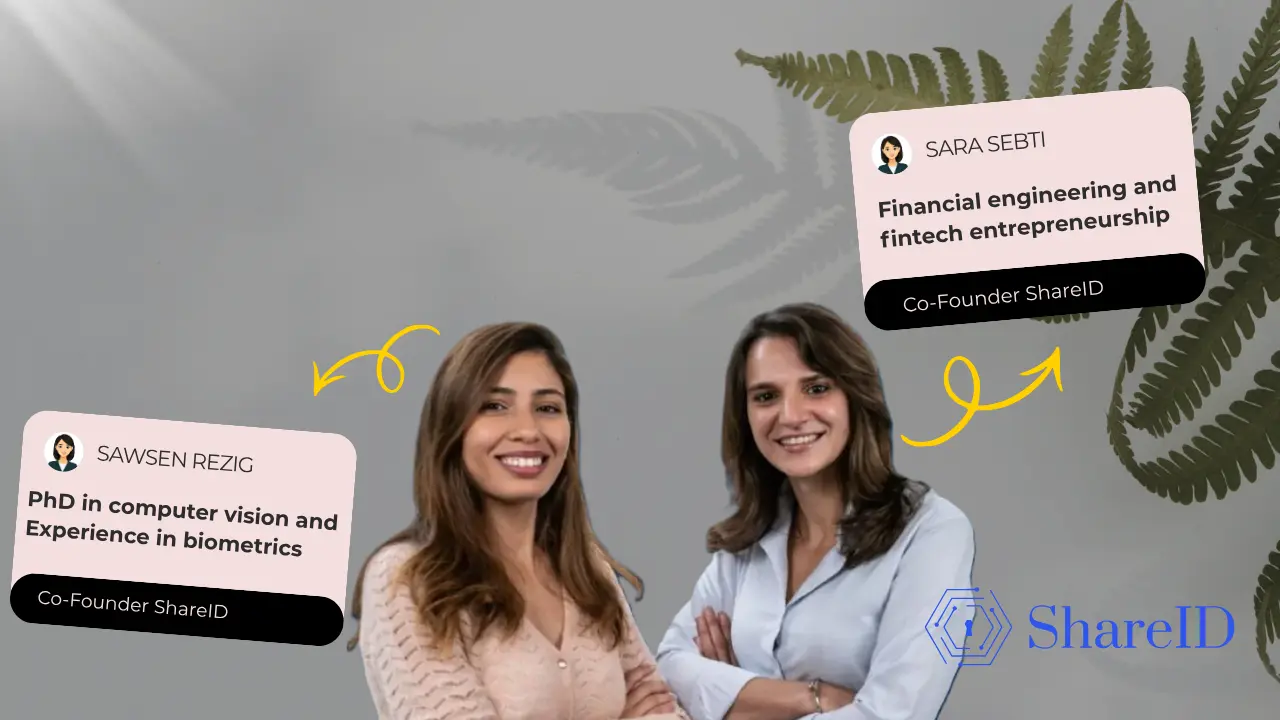
That was the case with ShareID, the French AI-powered digital identity startup cofounded by Sara Sebti and Sawsen Rezig.
What started as a personal inconvenience eventually became a privacy-focused identity authentication platform serving businesses dealing with fraud prevention, compliance, and secure customer verification.
But the most important lesson from ShareID’s story is not just the technology.
It is how the founders identified a painful real-world problem, understood the structural weakness behind it, and built a scalable business around trust, privacy, and digital security.
In 2020, Sara Sebti changed her phone number.
That simple action unexpectedly locked her out of her bank account for nearly three weeks because the bank could no longer authenticate her identity through its existing security systems.
For most people, this would have been a temporary annoyance.
For Sebti, it exposed something much larger:
modern digital identity systems were still highly fragmented, inefficient, and dependent on outdated authentication methods.
She later described the experience as “incredible” because such a small change created a major access problem in a highly digital financial system.
That moment became the foundation of ShareID.
The company was not built by beginners unfamiliar with finance or technology.
Sara Sebti had nearly a decade of experience working with regulatory and risk-related requirements inside financial institutions. Her background included financial engineering and fintech entrepreneurship.
Her cofounder, Sawsen Rezig, brought deep technical expertise:
This combination mattered enormously.
One founder understood:
The other understood:
Many startups fail because founders have only technical vision or only business understanding.
ShareID’s founders had both.
Sebti’s frustration revealed a structural issue affecting millions of users and businesses globally.
Traditional identity verification systems rely heavily on:
These systems create several problems:
The global shift toward digital banking, fintech, remote onboarding, and online financial services increased pressure on businesses to verify users securely while reducing friction.
This became especially important after:
Research in digital identity and self-sovereign identity has increasingly emphasized the importance of user-controlled, privacy-preserving authentication systems.
ShareID entered this market at the right time.
Many identity verification startups already existed before ShareID.
So the question became:
Why would businesses choose another identity platform?
The answer was privacy.
Unlike many competitors, ShareID positioned itself around a critical promise:
the company does not permanently store users’ personal or biometric data.
Instead:
This approach reduced:
At the same time, ShareID used AI-driven systems for:
The platform claimed document authenticity precision rates up to 99.9% across more than 120 countries.
In practical terms, the user experience became dramatically simpler:
instead of repeated manual verification, users could authenticate themselves with a simple facial verification process.
The company described this as:
“authentication with official identity.”
Many startup stories focus heavily on fundraising.
But ShareID’s early difficulty was data access.
To build effective AI systems capable of detecting authentic and fake identity documents, the startup needed high-quality datasets.
That was difficult.
According to Sebti, it took nearly a year to secure partnerships with the French military police to access the required databases for training their AI systems.
This is an important startup lesson:
deep-tech businesses often struggle more with infrastructure, datasets, regulations, and technical validation than with idea generation itself.
Ideas are cheap.
Execution barriers are not.
Several global trends accelerated demand for ShareID’s solution:
| Trend | Impact |
|---|---|
| Growth of digital banking | Increased remote verification needs |
| Rising cybercrime | Stronger authentication demand |
| Privacy regulations | Reduced appetite for storing user data |
| AI-powered fraud | Better identity verification required |
| Remote onboarding | Frictionless KYC became critical |
Identity fraud and digital impersonation have become major concerns across financial systems and online platforms.
Businesses increasingly needed systems that balanced:
That combination became ShareID’s positioning advantage.
ShareID attracted backing from investors including:
The company reportedly raised around:
The startup also expanded:
ShareID does not simply want to become another KYC platform.
Sara Sebti described the long-term ambition as becoming:
“the Google Connect with an official identity.”
That statement reveals the company’s strategic thinking.
The founders are not merely solving onboarding friction.
They are attempting to build a reusable identity trust layer for the internet.
If successful, such systems could eventually become core infrastructure for:
Sebti did not start with:
She started with:
a frustrating real-world problem.
The strongest startup ideas often emerge from:
ShareID’s founders deeply understood:
This reduced the gap between:
idea → execution.
Many founders underestimate how important industry understanding becomes in regulated sectors.
Most companies treat privacy as compliance.
ShareID turned privacy into product positioning.
That distinction matters.
As cyberattacks and data breaches increase, user trust itself becomes a market differentiator.
Training AI systems, obtaining datasets, ensuring compliance, and building enterprise-grade security infrastructure take time.
Deep-tech success rarely happens quickly.
The invisible work is often:
ShareID emerged during a period when:
Even strong ideas need the right market timing.
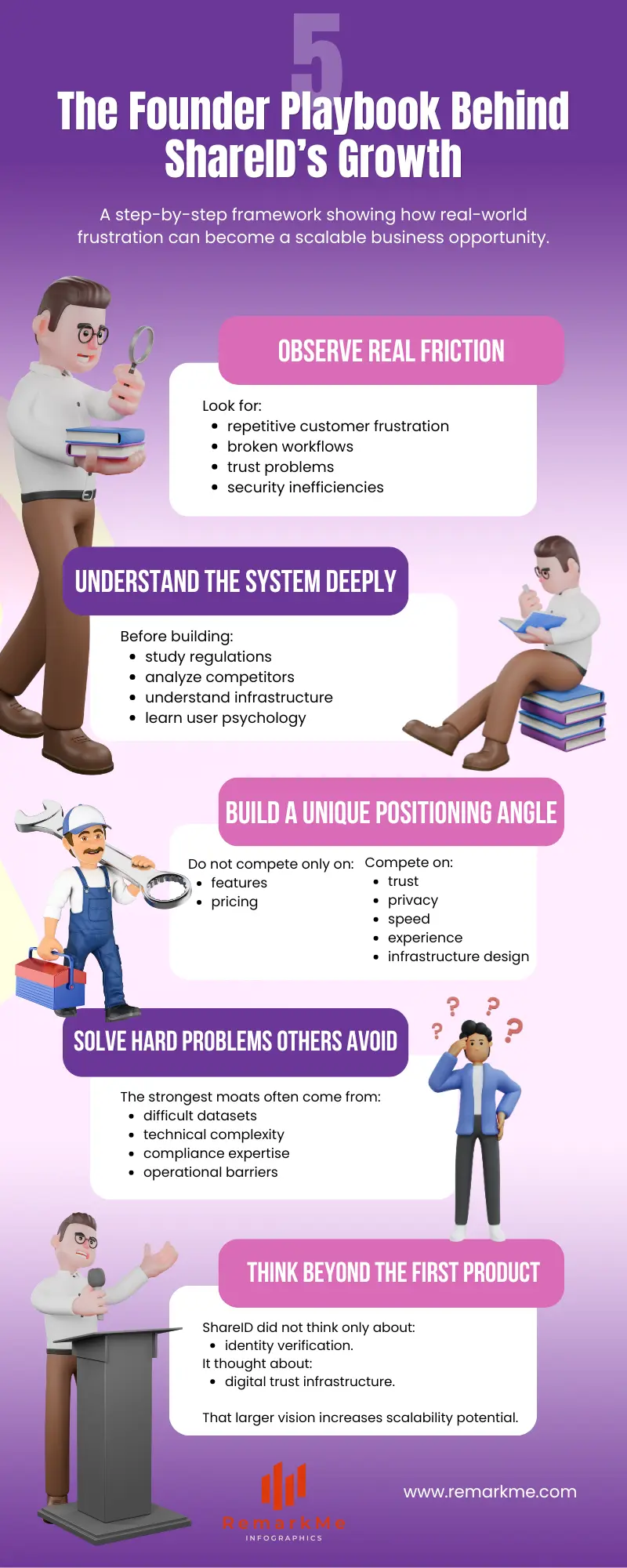
Look for:
Before building:
Do not compete only on:
Compete on:
The strongest moats often come from:
ShareID did not think only about:
identity verification.
It thought about:
digital trust infrastructure.
That larger vision increases scalability potential.
ShareID’s story is not a typical “garage startup” narrative.
It is a case study in:
The most important insight from Sara Sebti’s journey is this:
A startup opportunity often hides inside an everyday frustration that millions of people silently accept as normal.
Exceptional founders are the people who refuse to accept it.